
Specifying passenger elevators Pakistan buildings can rely on for 25 years is a design-stage decision, not a purchasing one. Capacity, shaft dimensions and the traffic calculation are fixed the moment the core is poured.
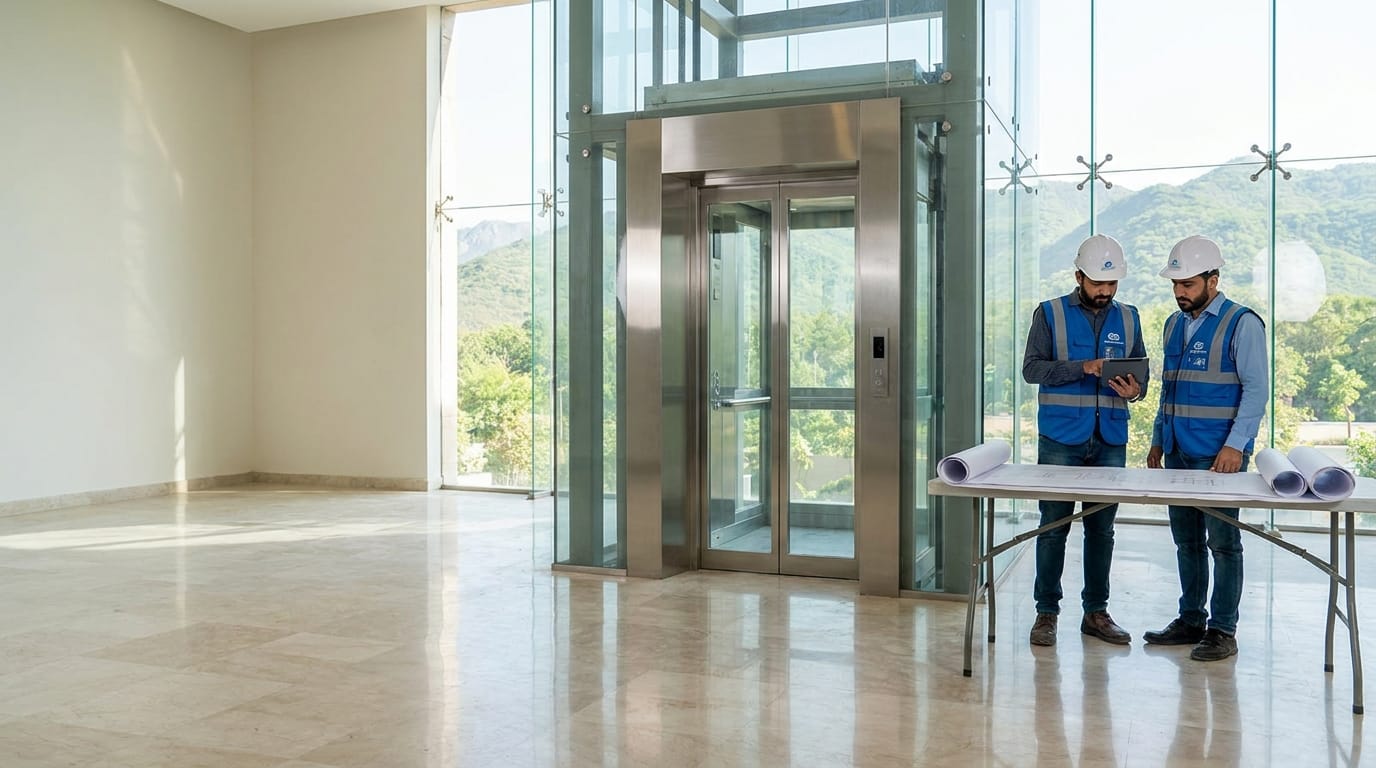
Specifying a passenger elevator is a decision you live with for 20 to 25 years. Get the capacity, shaft dimensions and traffic calculation right at design stage and the lift disappears into the background of the building. Get them wrong and you are looking at queues in the lobby, structural rework, or a machine that runs hot because it was undersized for the load it actually carries.
This guide is written for the people who make that decision in Pakistan — architects sizing a core, developers comparing tenders, facility managers replacing ageing equipment, and homeowners adding a lift to an existing house. It covers drive systems, capacity and sizing, shaft and pit requirements, speed selection, safety standards, and the questions worth asking any supplier before you sign.
Hub Elevator has been installing vertical transport in Pakistan since 1970, originally as Haji Hameed Engineers & Suppliers, with 362 completed projects across hospitals, banks, industrial plants and residential towers. The guidance below reflects what we see on site, not a brochure.
Where passenger elevators are used — and why the building type matters
A passenger elevator is any lift designed to move people rather than goods. That single definition covers wildly different machines, because the duty cycle changes everything about the specification.
- Residential apartments — moderate traffic, long idle periods, cost and running efficiency matter more than speed. Typically 6 to 8 persons.
- Commercial offices — sharp morning and evening peaks. Traffic analysis matters far more than headline capacity; two smaller lifts usually beat one large one.
- Hospitals — bed lifts need a deep car (minimum 2400 mm) to take a stretcher with attendants, plus levelling accuracy for trolleys. See our guide to hospital elevators in Pakistan.
- Hotels — guest lifts and service lifts should be separate. Ride quality and finish are part of the product.
- Industrial and factory — passenger lifts here often sit alongside a cargo or freight elevator. Do not use one to do the other’s job.
- Private homes — space is the binding constraint, not capacity. Compact and shaftless options change the calculation.
If you are weighing a passenger lift against a goods lift for mixed use, our passenger vs cargo elevator comparison sets out the differences in car construction, door type and duty rating.
Drive systems: traction, gearless and hydraulic
Almost every passenger lift specified in Pakistan today falls into one of three drive types. The choice is driven by travel height, available machine space and ride quality expectations.
| Drive type | Typical travel | Speed range | Best suited to | Trade-off |
|---|---|---|---|---|
| Geared traction | Up to ~12 floors | 0.5 – 1.0 m/s | Mid-rise residential and commercial | Lower cost; slightly more noise and vibration than gearless |
| Gearless traction | 8 floors and above | 1.0 – 6.0 m/s | High-rise, hotels, premium offices | Higher capital cost; smoother ride, lower running cost |
| MRL (machine-room-less) | Up to ~20 floors | 1.0 – 2.5 m/s | Sites with no room for a machine room | Saves the machine room; serviceability requires trained technicians |
| Hydraulic | Up to ~6 floors | 0.15 – 0.63 m/s | Low-rise, home lifts, heavy loads at low height | Slow; higher energy use per trip; no machine room at the top |
The short version: below six floors hydraulic is viable and often cheaper to install; between six and twelve, geared traction is the workhorse; above twelve, gearless is the only sensible answer. Our detailed comparison of hydraulic versus traction systems goes deeper on running costs and maintenance implications.
Speak to an engineer
Specifying a passenger lift for your building?
Capacity, speed, shaft dimensions and expected traffic all decide the specification — and getting any of them wrong is expensive to correct later. Tell us the building type and floor count and our engineers will size the lift properly and quote it.
Free site surveys across Karachi, Lahore, Islamabad and Rawalpindi. Part of Haji Hameed Engineers and Suppliers, in the industry since 1970. 362 completed projects.
Capacity and car sizing
Every specification for passenger elevators Pakistan projects starts here. Rated load drives the motor, rails, ropes and shaft, so capacity must be agreed before the structure is designed.
Passenger lift capacity is expressed both in persons and in kilograms, and the two are linked by a standard assumption of 75 kg per person under ISO 4190-1 and EN 81-20. The figures below are the internationally standard sizes you will see quoted by every major manufacturer supplying Pakistan.
| Rated load | Persons | Typical car width × depth | Common application |
|---|---|---|---|
| 320 kg | 4 | 1000 × 900 mm | Home lifts, small residential |
| 450 kg | 6 | 1000 × 1250 mm | Small apartment buildings |
| 630 kg | 8 | 1100 × 1400 mm | Standard residential — the most common size in Pakistan |
| 800 kg | 10 | 1350 × 1400 mm | Mixed residential / small office |
| 1000 kg | 13 | 1600 × 1400 mm | Offices, hotels |
| 1275 kg | 17 | 2000 × 1400 mm | Commercial, high-traffic |
| 1600 kg | 21 | 1950 × 1750 mm | Hospitals (bed lift), large commercial |
| 2000 kg | 26 | 2000 × 2000 mm | Hospital bed lifts, high-rise service |
A note on hospital lifts: the constraint is not weight, it is depth. A stretcher plus two attendants needs a car depth of at least 2400 mm regardless of what the load rating suggests. Specifying a 1600 kg lift with a 1750 mm car depth will pass a load test and fail in daily use.
Shaft, pit and headroom requirements
This is where most projects lose money. The shaft is poured before the lift is ordered, the dimensions do not match, and the fix is either a smaller car than the client wanted or breaking concrete.
| Rated load | Typical shaft (W × D) | Pit depth | Headroom (top floor to slab) |
|---|---|---|---|
| 450 kg | 1500 × 1600 mm | 1200 mm | 3600 mm |
| 630 kg | 1600 × 1750 mm | 1400 mm | 3800 mm |
| 800 kg | 1850 × 1750 mm | 1400 mm | 3800 mm |
| 1000 kg | 2100 × 1800 mm | 1500 mm | 4000 mm |
| 1275 kg | 2500 × 1800 mm | 1600 mm | 4200 mm |
| 1600 kg | 2400 × 2200 mm | 1600 mm | 4200 mm |
Treat these as indicative planning figures. Pit depth and headroom both increase with rated speed — a 1.6 m/s lift needs more overtravel than a 1.0 m/s lift of identical capacity. Final dimensions must come from the manufacturer’s approved general arrangement drawing for the exact model, and that drawing should be in your hands before the shaft is cast.
For a fuller breakdown including door openings and machine room dimensions, see our complete guide to elevator dimensions.
Get the shaft checked before you pour
Hub Elevator reviews shaft drawings free of charge for projects anywhere in Pakistan. Send us your architectural section and we will confirm whether the opening, pit and headroom will take the car you have specified. Request a drawing review.
Choosing rated speed
Speed is not a luxury specification — it is a function of travel height. Under-speccing produces unacceptable waiting times; over-speccing wastes capital and increases pit and headroom requirements.
| Building height | Recommended speed | Drive type |
|---|---|---|
| Up to 6 floors | 0.63 – 1.0 m/s | Hydraulic or geared traction |
| 6 – 12 floors | 1.0 – 1.6 m/s | Geared traction or MRL |
| 12 – 20 floors | 1.6 – 2.5 m/s | Gearless traction |
| 20 – 30 floors | 2.5 – 4.0 m/s | Gearless traction |
| Above 30 floors | 4.0 m/s and above | Gearless, usually zoned |
Above roughly 20 floors, a single bank serving every level stops working. Buildings are zoned — low-rise, mid-rise and high-rise groups — so that no lift makes an excessive number of stops. Our guide to high-rise elevator design covers zoning and traffic analysis, and Hub Elevator supplies high-rise lift installation up to 40 storeys.
Doors, finishes and control
Door type is the most-used moving component in the entire installation and the commonest source of callouts. Centre-opening doors are faster and are standard for commercial use; side-opening doors give a wider clear opening for the same shaft width, which matters in tight cores. Manual swing doors still appear in low-cost residential work and are a false economy — they are the single most common cause of entrapment complaints.
Control system matters more than most buyers realise. Simplex control serves a single lift. Duplex links two. Group control across three or more cars, with destination dispatch on larger installations, can cut average waiting time substantially without adding a single machine. If you are specifying more than two lifts, ask the supplier for a traffic calculation, not just a product sheet.
Finishes — hairline stainless steel is the practical default for high-traffic buildings; mirror and etched finishes look better in photographs and show every fingerprint. Where cabin refurbishment is the goal rather than replacement, see elevator wall panel upgrade options.
Safety standards and compliance
Because Pakistan operates no single mandatory lift code, the compliance standard for passenger elevators Pakistan installations has to be written into your tender rather than assumed.
Pakistan does not currently operate a single mandatory national lift code, which places the burden of specifying compliance on the buyer. Reputable installations here are built to one of two international frameworks:
- EN 81-20 and EN 81-50 — the European standard for construction and installation of passenger and goods lifts. This is the dominant reference for equipment imported from Europe, Turkey and most Far East manufacturers.
- ASME A17.1 / CSA B44 — the North American safety code for elevators and escalators, referenced by US-origin equipment.
Whichever framework you specify, the non-negotiable safety devices are: overspeed governor and safety gear, buffers sized for rated speed, door interlocks on every landing, an emergency stop and alarm inside the car, automatic rescue device (ARD) for power failure, and firefighter recall. In Pakistan, where load-shedding remains a routine reality, an ARD is not optional — without one, a power cut leaves passengers stranded between floors.
Our detailed treatment of elevator safety standards in Pakistan sets out how to write compliance into a tender document so it is enforceable rather than aspirational.
Brands available in Pakistan
For passenger elevators Pakistan owners run daily, spare-part availability and local technician coverage matter far more than the badge on the car.
The market splits into three tiers: fully imported units from Japanese and European manufacturers, semi-imported units where the major components are imported and the cabin and structure are fabricated locally, and locally assembled units. Hub Elevator supplies across all three, working with Fuji, Mitsubishi Electric, Hyundai, Sigma, Montanari and Yaskawa among others — the full list is on our brands page.
The honest guidance: brand matters less than the availability of spare parts and trained technicians in your city. A premium lift with a four-week lead time on a replacement door operator will frustrate you more than a mid-tier lift whose parts sit in a Karachi warehouse. Ask any supplier where their spares are held and what their mean response time is — then ask for a reference you can call.
Installation: what actually happens, and how long it takes
A typical passenger lift installation in a new building runs as follows:
- Site survey and drawing approval — shaft dimensions confirmed against the manufacturer’s general arrangement drawing.
- Order and manufacture — lead time varies substantially by origin and specification.
- Shaft handover — the builder hands over a plumb, dry shaft with the correct pit, headroom and openings. Delays here are the commonest cause of programme slip.
- Guide rail and machine installation.
- Car assembly, roping and door installation.
- Wiring, commissioning and load testing — including overspeed governor and safety gear tests at rated and reduced load.
- Handover, documentation and operator training.
The step buyers most often skip is the last one. Insist on the wiring diagrams, the parts list and a maintenance manual at handover. Without them you are locked into your original installer for the life of the equipment. Our full walkthrough of the elevator installation process covers each stage in detail.
What drives the cost of a passenger elevator
Every quotation is a function of the same seven variables. Understanding them lets you compare tenders that look superficially different:
- Rated load and car size — the single largest driver.
- Number of stops and total travel height — more landings means more doors, more wiring, more rail.
- Rated speed — drives motor sizing, controller and buffer specification.
- Drive type — gearless costs more upfront and less to run.
- Origin — fully imported, semi-imported or locally assembled.
- Cabin finish and door type — often 10–20% of the total and the easiest place to overspend.
- Maintenance contract — a comprehensive AMC costs more than a basic one and usually costs less over ten years.
For a fuller treatment including how these factors interact, see our guide to what drives elevator prices in Pakistan. We quote against a site survey rather than a price list, because the honest answer to “what does a lift cost” is that it depends on the shaft you already have.
Maintenance and lifecycle
Well-maintained passenger elevators Pakistan buildings install today should give 20 to 25 years of service; neglected ones give roughly half that.
A passenger elevator has a design life of 20 to 25 years with proper maintenance, and roughly half that without it. Servicing should be monthly for high-traffic commercial installations and at minimum quarterly for low-traffic residential.
The decision that matters most at year 15 to 20 is modernisation versus replacement. If the shaft, rails and structure are sound, replacing the controller, drive and door operators typically restores performance and energy efficiency at a fraction of full replacement cost. See our guide to elevator AMC and maintenance contracts for what a service agreement should actually cover.
A checklist for evaluating any supplier
- Which safety standard is the equipment built to — EN 81-20 or ASME A17.1? Ask for the certificate, not the claim.
- Is an automatic rescue device included as standard?
- Where are spare parts held, and what is the guaranteed response time for a breakdown in my city?
- Will you provide a general arrangement drawing before the shaft is cast?
- What is included in the warranty, and what is excluded?
- Can I speak to a client with a comparable installation that is five years old or more?
- Who carries out the maintenance — your own technicians or a subcontractor?
That last question separates most of the market. Ask it early.
Frequently asked questions
What size shaft do I need for an 8-person passenger lift?
A 630 kg, 8-person passenger lift typically requires a shaft of approximately 1600 mm wide by 1750 mm deep, with a pit depth of around 1400 mm and headroom of about 3800 mm above the top floor. These are planning figures — confirm against the manufacturer’s approved drawing before casting the shaft.
What is the difference between a passenger elevator and a cargo elevator?
A passenger elevator is built for ride comfort and frequent starts, with lighter car construction, automatic doors and levelling accuracy suited to people. A cargo or freight elevator is built for load, with a reinforced car, heavy-duty flooring and often manual or vertical bi-parting doors. Using a passenger lift to move heavy goods voids most warranties and shortens equipment life considerably.
How many passengers should a lift in an apartment building carry?
For most residential buildings in Pakistan, a 630 kg 8-person lift is the practical standard. Buildings above roughly ten floors, or with more than four apartments per floor, generally justify either a larger 1000 kg car or a second lift, based on a traffic calculation rather than a rule of thumb.
Do I need a machine room?
Not necessarily. Machine-room-less (MRL) lifts place the drive within the shaft and are suitable up to roughly 20 floors. They save valuable roof space, but require technicians trained on that specific system, so confirm local service capability before specifying one.
What happens to a lift during a power cut?
With an automatic rescue device fitted, the lift moves to the nearest landing on battery power and opens its doors. Without one, passengers remain in the car until power is restored or a manual rescue is performed. Given load-shedding conditions in Pakistan, an ARD should be treated as an essential specification, not an upgrade.
How long does installation take?
Once the shaft is handed over plumb, dry and complete, mechanical installation and commissioning of a standard passenger lift is a matter of weeks rather than months. The dominant variables are equipment lead time and builder readiness, not the installation itself.
What speed do I need?
Up to six floors, 0.63 to 1.0 m/s is adequate. Between six and twelve floors, specify 1.0 to 1.6 m/s. Above twelve floors, 1.6 m/s upward with gearless traction. Higher speed increases pit and headroom requirements, so decide before the structure is designed.
How often should a passenger elevator be serviced?
Monthly for high-traffic commercial, hotel and hospital installations. Quarterly is the minimum acceptable interval for low-traffic residential buildings. Servicing intervals shorter than the manufacturer’s recommendation rarely cause harm; longer ones consistently shorten equipment life.
Can a passenger lift be installed in an existing building?
Yes. Retrofit installations are routine, either within an existing stairwell void, in a purpose-built external shaft, or as a compact self-supporting structure. The constraint is usually pit depth, since excavating below an existing ground slab is the most disruptive element. A site survey will establish feasibility quickly.
Which elevator brand is best for Pakistan?
No single brand is best across all cases. Fully imported Japanese and European equipment offers the highest build quality; semi-imported units offer a strong balance of quality and serviceability. The more important variable is local spare-part availability and technician coverage in your city, which affects downtime far more than the badge on the car.
Get your passenger lift specified and quoted
Send us the building type, number of floors and available shaft space. We will return a full specification, a costed proposal and a delivery timeline.
Talk to an engineer, not a salesperson
Hub Elevator has supplied and installed passenger elevators across Pakistan since 1970 — for the State Bank of Pakistan, Bahria Town, Ziauddin University, NADRA, Imtiaz and 350-plus other clients — from head offices in Karachi and Lahore and an office in Dubai.
If you are at design stage, send us your drawings and we will review the shaft, pit and headroom against the car you want and tell you plainly whether it works. If you are comparing tenders, we will tell you what the differences between them actually mean.
Request a free site survey or call (021) 34534001. You can also see the full range of passenger elevator services we provide.